

Denitrification zone: technology reducing area pollutants (in particular, nitrogen), which employs denitrification deposits enriched with bacteria cultures, improves ecological quality of lakes and watercourses.
Characteristic features of our technology:
- high effectiveness of nitrate reduction (8-10-fold),
- effect durability: deposit remains effective for up to 15 years,
- low cost of denitrification deposit construction,
- denitrification deposit based exclusively on natural components,
- no interference with landscape,
- reinforcement of ecotone zones in protecting waters against area pollutants.
P.404407 Patent Application: Denitrification deposit to reduce area pollutants in agricultural catchment.
Name of research project, under which P.404407 application was made: Project NCBR Nr N R14 0061 06: “Development of model non-woven geotextile, biodegradable biological deposits to remove nitrogen and phosphorus pollutants in high-risk agricultural production areas”.
The area pollutant removal denitrification deposit under offer is one of the cheapest biotechnologies developed to prevent migration of nitrates from areas of intense agricultural use to the aquatic environment. The method consists in construction of denitrification deposits to reduce area pollutants in the vicinity of aquatic ecosystem shorelines. Such a deposit is set up perpendicular to the flow of nitrate-polluted groundwater, which in most cases is runoff from areas of intense agricultural use, i.e. from farmland or pastures. The deposit’s task is to activate the process of denitrification and reduce nitrates to gas forms (N2O predominantly to N2). It is most convenient to build such structures in the vicinity of river, lake, or dam reservoir shorelines. Depth and width of a deposit depend on the range of ground water levels. Use of fibre materials containing organic carbon that are easiest and cheapest to obtain in a given region, as well as individual adjustment of the proportions in which the materials are used in a deposit at a given area will make effective reduction of nitrogen compounds possible. Furthermore, a certain pool of denitrification microorganisms is applied to the deposit. Addition of microorganisms improves the effectiveness of denitrification processes, as well as makes effective operation of a deposit possible even in the conditions of long-term draught (in such case, the restored nitrate reduction effectiveness of a deposit can be as high as 90%). The presented solution does not interfere with landscape, as deposits are located underground and remain invisible to the outside observer.
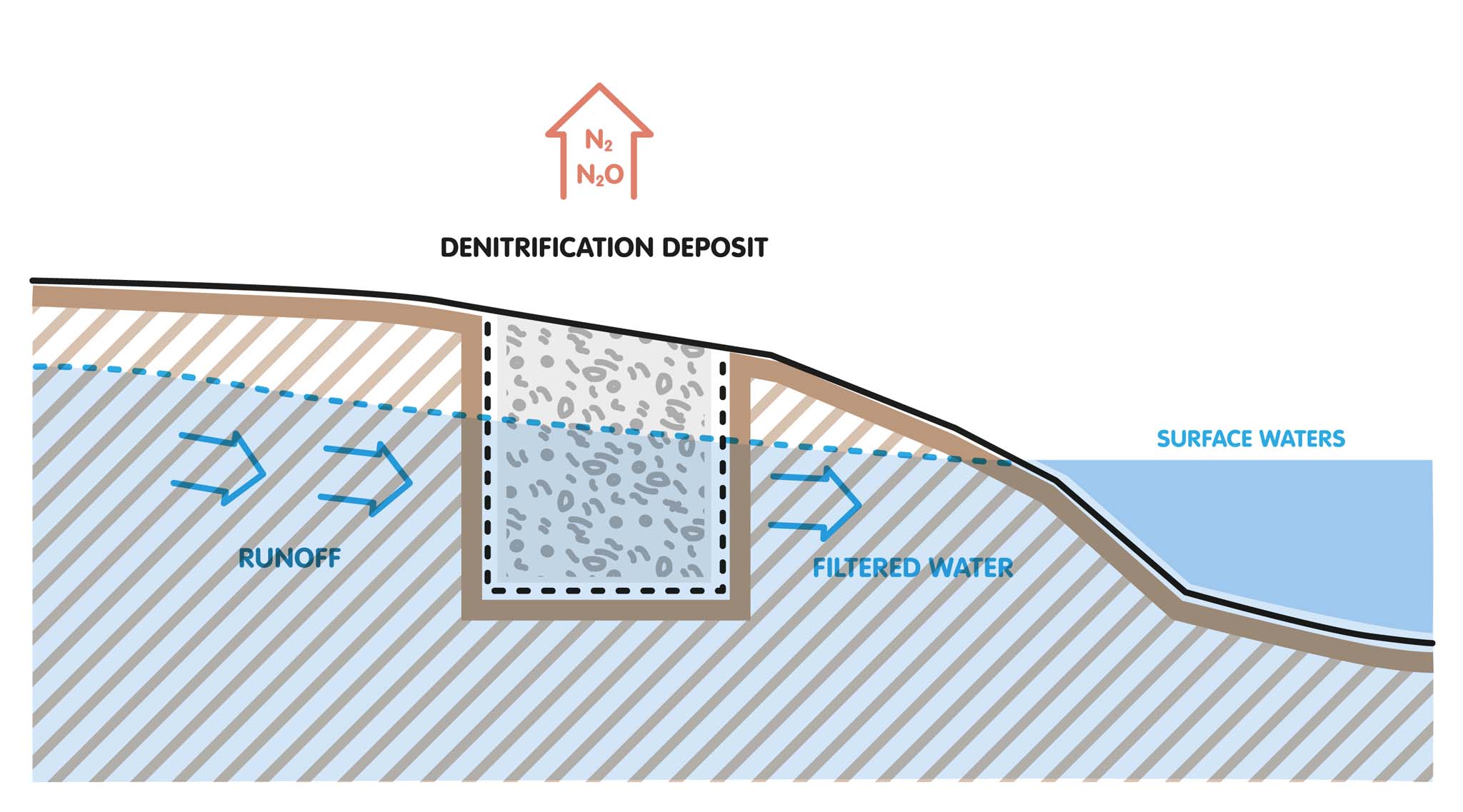
The following table shows nitrate-reduction levels on application of the technology offered.
| Source of pollution | Average reduction in entire deposit operation period (%) | Highest concentration recorded (mg/l) | Maximum reduction (%) |
| farmland | 50 | 90 NO3- | 88.0 |
A number of qualities mark the technology’s innovatory character:
- unevenness of denitrification deposit operation is minimised – unlike hitherto used processes, fragmentation and esterification of fibre materials included in the deposit has been employed,
- high effectiveness of deposit – employment of bacteria cultures yields 8-10-fold reduction of nitric pollutants reaching the reclaimed water ecosystem,
- high durability of nitric pollutant reduction results – owing to employment of microorganisms in the pollutant-reduction process, the deposit is assumed to operate effectively for a period of up to 15 years.