

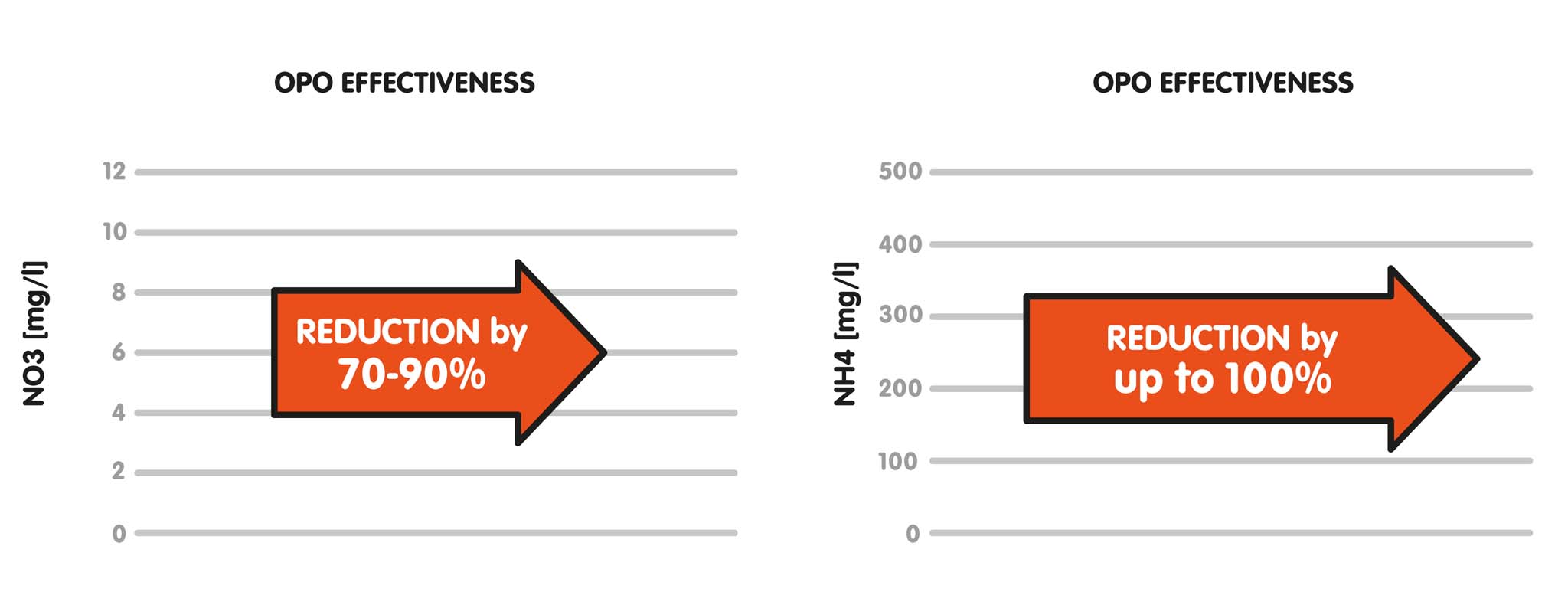
Organic Manure Plate (Organiczna Płyta Obornikowa – OPO) – technology which enables reduction of point source pollutants from agricultural production environment. Organic manure plate for storage of solid animal waste (manure, faeces) is a specially designed layer of carbon substrates located under manure storage site, which constitutes a vertical barrier for runoff of contaminated groundwater. In the event of long-term draught, application of additional pool of denitrification microorganisms into the deposit quickly restores its efficiency and reduces concentration of nitrates by over 90%.
P.418169 Patent Application: Organic Manure Plate.
Name of research project under which P.418169 application was made: Project NCBR No. PBS1/A8/2012: “Microbiological activators in denitrification deposits used for treatment of nitrate pollution as part of implementation of Water Framework Directive and Nitrates Directive”.
The technology is characterised by innovatory construction procedure, the so-called horizontal and vertical barrier arrangement whose aim is to remove nitrogen compounds from effluents generated by point source pollutants, i.e. manure deposit sites. The technology has been developed with innovatory character of pro-environmental solutions in mind, which are the source of new useful products intended to contain spread of anthropogenic (agricultural and municipal) pollutants, and, consequently, improve surface and groundwater quality, as well as the condition of man’s environment. The service involves construction of organic manure plate (OPO) for storage of solid animal waste (manure, faeces). Its execution consists in securing adequate manure conditioning process, and, in effect, its maximum fertilising quality, as well as relevant humus-generating activity in soil in the presence of suitable microbiological activators. Such activator is made of appropriately selected strains of fermenting bacteria able to survive and grow in the conditions of manure pile environment. Its task is to effectively colonise the manure environment, and adequately direct processes that take place in it. Furthermore, as appropriate metabolites are released into the substrate, elimination of potentially present pathogens, as well as containment of their proliferation in the environment becomes possible. OPO’s construction includes a specially selected source of organic carbon, which stimulates development and activity of endogenous populations of microorganisms, i.e. denitrification and nitrification bacteria. As a consequence, ammoniacal nitrogen present in agricultural effluents is oxidised (nitrification) to nitrates, whereas nitrates present in the effluents, as well as those formed in the process of ammonia nitrification undergo further denitrification to gaseous nitrogen. Complete pollutant reduction period, in which chemical-biological balance is reached by a newly-constructed OPO, is ca. 1.5 months.
To protect the plate against the risk of prolonged draught (long-term draught exposure of the deposit is a threat to the efficiency of denitrification deposits, as well as to microorganisms present in them) the deposits are assembled in such a way, as to form a layer under a manure storage site, as well as a barrier for runoff of contaminated ground water. Application of an additional pool of a microbiota (our own autochthonous-microorganism-based vaccine) to a draught-affected deposit quickly restores its efficiency (reduction level exceeds 90%).
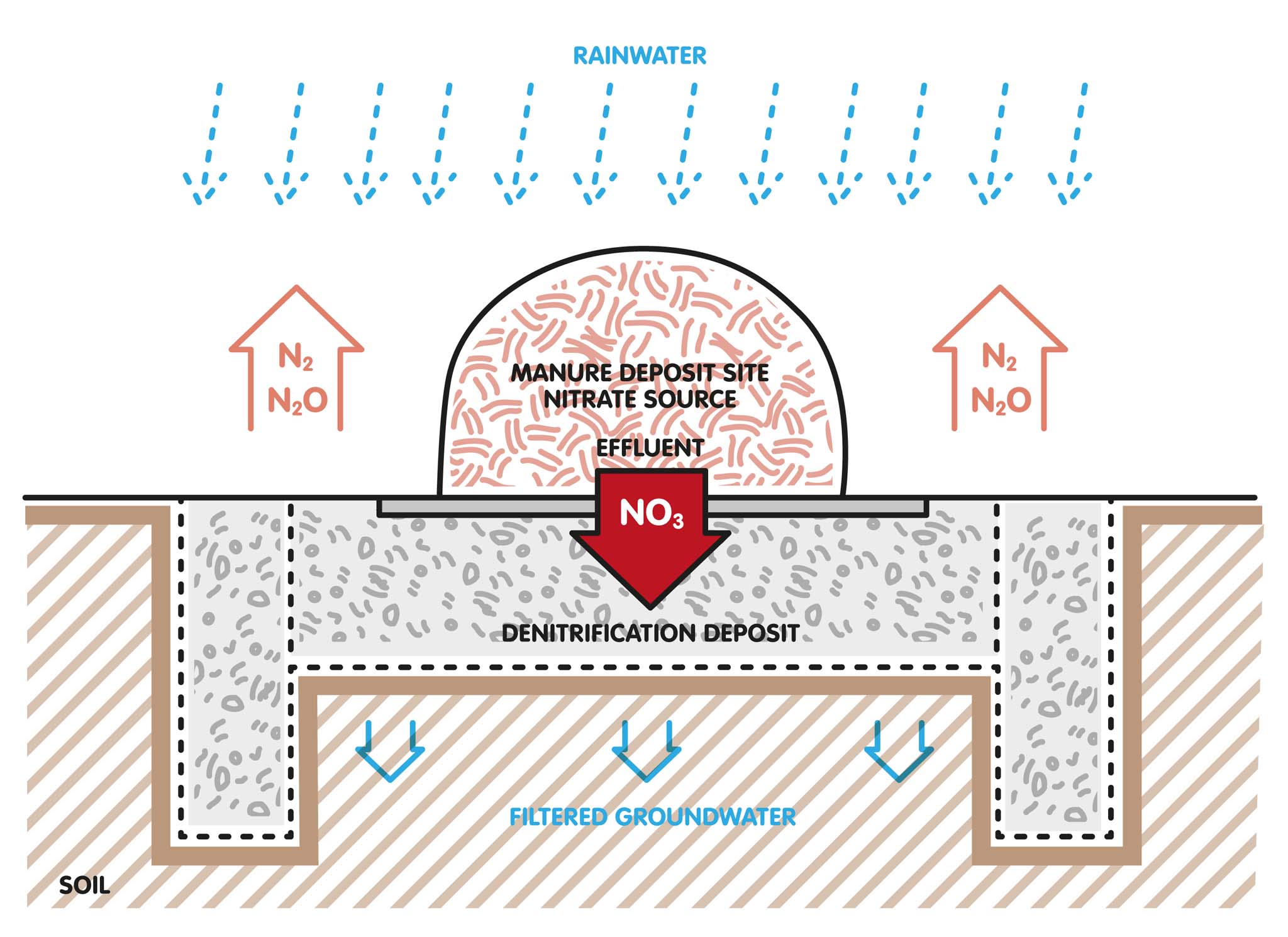
Use of manure plate yields the following nitrate-reduction levels:
| Source of pollution | Average reduction in deposit operation period (%) | Highest concentration recorded (mg/l) | Maximum reduction (%) |
| manure (bovine) | 65 | >200 NO3- | 84.8 |
| manure (bovine) | 51 | 339 NO3- | 94.8 |
| manure (porcine) | 85 | 361 NO3- | 95 |
The existing manure plates and slurry containers do not fully protect the environment against pollution.
Results of the basic project have shown that in crop and livestock farms, nitrate concentration in manure-storage-site effluents which penetrate to ground water can exceed 2000 mg dm-3. It constitutes massive contamination of ground waters in the vicinity of such storage sites, and does not meet the requirements of the Nitrates Directive (91/676/EWG), thus contributing to eutrophication of surface waters.
For this reason, in several cases application of the presented technology becomes indispensable.